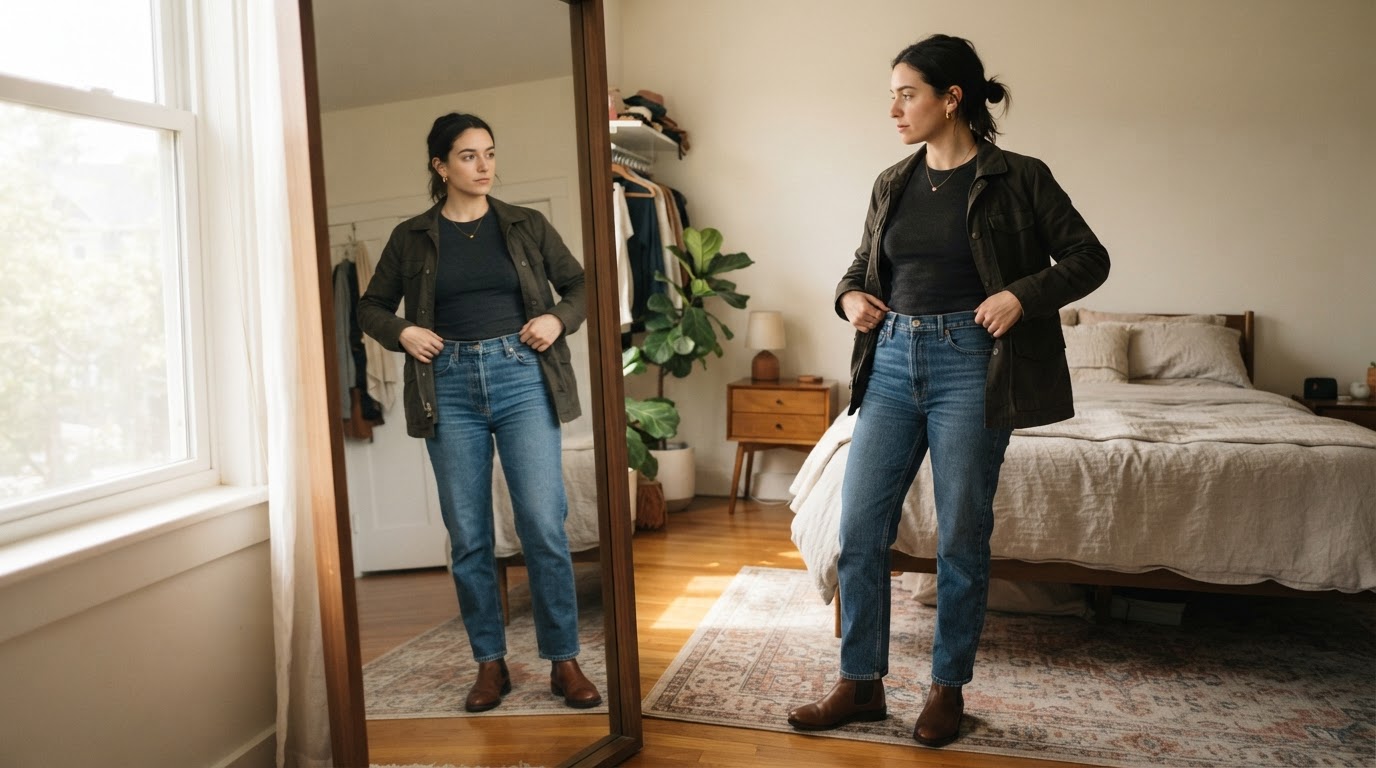
The short answer: a new look is a new combination, not a new purchase
Most wardrobes already hold enough pieces to build a different outfit; what goes stale is the combination, not the clothes. The items you reach for every week are usually the right items — they are simply worn in the same order, with the same shoes, at the same lengths.
That is why a new purchase rarely fixes the feeling. A fresh piece gets absorbed into the same formula and starts to read like everything else you own within a month. Restyling runs the other way: keep the base, change how it is assembled, then judge the result.
Four levers do most of the work:
- Fit — hem length, sleeve length, shoulder line, and how the fabric hangs.
- Color balance — which piece dominates, which supports, and which accents.
- Proportion — where the outfit divides vertically and where the volume sits.
- Styling — shoes, belt, bag, jewelry, outerwear, and the details that frame everything else.
Move one lever at a time. Change all four at once and you cannot tell which adjustment helped — and the result usually reads as a costume rather than an outfit.
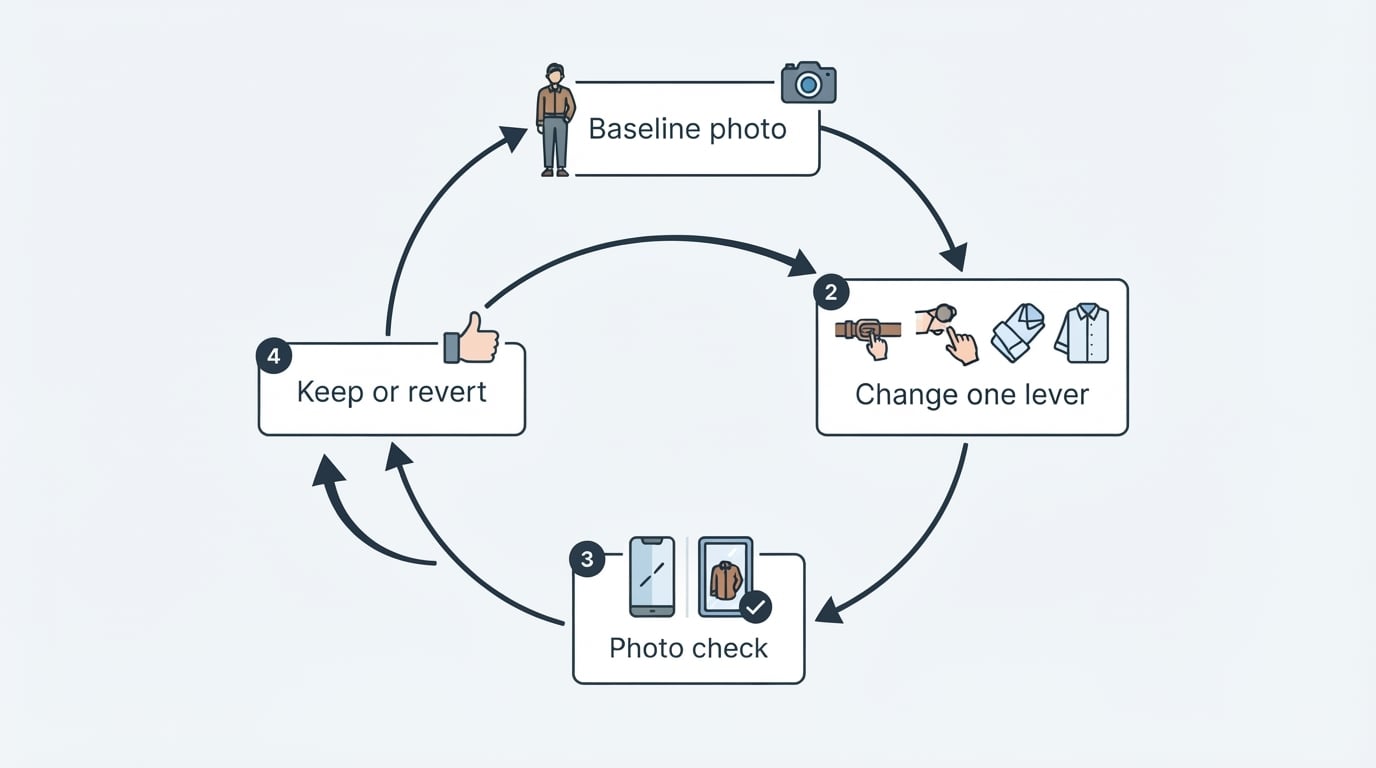
Key answers: how to restyle my outfit without buying new clothes
How do I restyle my outfit without buying anything? Change one variable — fit, color, proportion, or styling — on an outfit you already trust, then photograph the result before you decide it works.
What should I change first? Fit. A well-fitted outfit looks intentional even when the pieces are plain, and no color pairing hides a hem that breaks in the wrong place.
How many new outfits can one wardrobe produce? More than most people try. Five tops, three bottoms, and two pairs of shoes already make thirty combinations, and the usual bottleneck is that only a handful have ever been worn.
Do I need to buy anything? No. The useful purchases are maintenance tools rather than clothing — a shoe brush, a steamer, a lint roller, and a tailor's time.
How do I know a restyled look works? Take a full-body photo, then view it at thumbnail size. If the silhouette reads clean and one element leads the eye, it works; if your eye has no landing point, one piece is doing too much.
Before you start, audit what you actually wear
Start with the pieces you already reach for, not the ones you wish you wore. Pull out eight to ten items — shoes included — that have left the house in the last month. That group is your working wardrobe, and it is where new combinations are cheapest to find.
Lay everything out where you can see it at once, then assemble one complete outfit from that pile. Put it on and take a head-to-toe photo at chest height. Do not style it yet; you are recording a baseline.
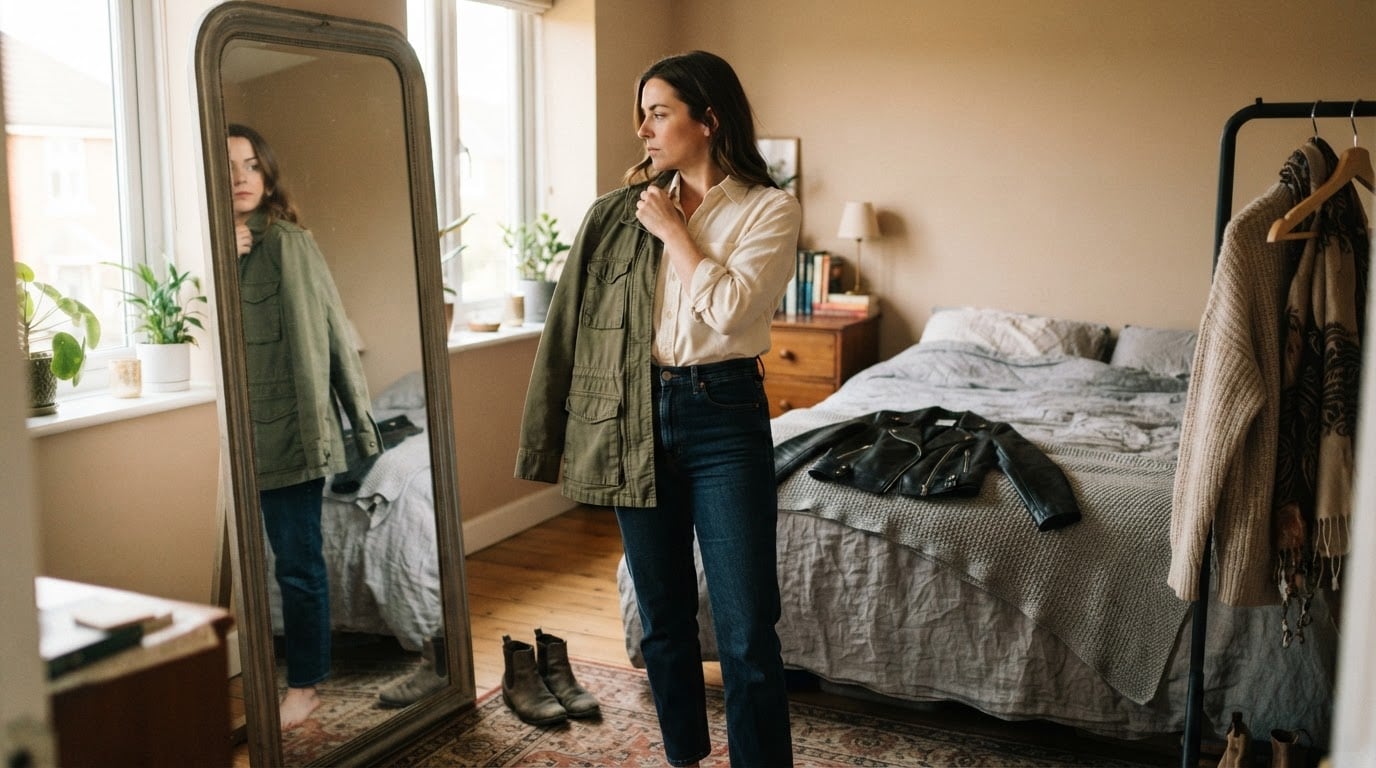
From that photo, note two things: what you like about the outfit, and the single point where your eye stops. That one point becomes the target for everything that follows. Restyling gets easier when you are fixing one thing instead of redesigning your entire look.
Lever 1: Fix the fit before you change anything else
Fit is the lever with the largest effect and the lowest cost. A hem that lands cleanly, a sleeve that ends near the wrist bone, and a shoulder seam that sits where your shoulder actually is will change how an outfit reads before color or accessories enter the picture.
Most fit fixes are adjustments rather than alterations:
- Cuff or hem trousers and jeans so the fabric breaks once, not twice.
- Set the waistline with a tuck, a half-tuck, or a cropped layer.
- Roll sleeves to a deliberate point instead of letting them bunch at the cuff.
- Swap the belt for a slimmer or wider version to change where the waist reads.
- Use a tailor for hems, sleeve shortening, and waist take-in — repair money, not clothing money.
If a garment cannot be adjusted into a clean line, no combination will rescue it. Set it aside rather than building outfits around it.
Lever 2: Rebalance color and contrast
Color problems are usually balance problems. An outfit reads flat when every piece sits at the same value, and noisy when three pieces compete for attention at once.
A workable default is a dominant color, a supporting color, and a small accent — roughly a 60/30/10 split. The dominant piece covers most of your body, the supporting piece raises or lowers contrast, and the accent is the detail that gives the eye a destination.
Adjustments that take seconds:
- Break one match. If your top and trousers are the same tone, add a belt, jacket, or shoe in a different value.
- Repeat one color twice. A color that appears in two places looks deliberate; a color that appears once can look accidental.
- Trade shine for texture. When two pieces look similar, changing the surface — knit against denim, matte against leather — separates them without adding a new color.
Lever 3: Change the proportion
Proportion decides where the outfit divides and where the volume sits. The same top, trousers, and shoes can look short or long, sharp or slouchy, depending only on those two decisions.
Try one change at a time:
- Raise the waist. Tuck the top or move the belt line up so the legs start higher.
- Change the outer length. A jacket that ends at the hip gives a different read than one that ends mid-thigh.
- Keep one volume. If the trousers are wide, keep the top closer to the body; if the top is oversized, keep the bottom narrower.
- Expose one edge. A visible ankle, wrist, or collar line gives a heavy outfit a place to breathe.
The goal is not to look taller or slimmer by rule. It is to make the line of the outfit look chosen rather than accidental.
Lever 4: Change the styling layer
Shoes, belts, bags, jewelry, and outerwear change the formality and the mood fastest, because they sit at the edges of the outfit where the eye lands first.
- Change the shoe last. The same outfit with a chunky sneaker, a loafer, and a boot is three different outfits.
- Remove one accessory. Restyling does not mean adding; deleting a scarf, a watch, or a second ring often clarifies a look.
- Match the metal. Keeping belt hardware, watch, and jewelry in one metal family makes a low-effort outfit look finished.
- Change the sock. A visible sock can separate shoe from trouser or connect them; pick one and keep it consistent.
Test the combination before you leave the house
Photograph the restyled outfit the same way you photographed the baseline, then compare the two side by side. A full-body photo removes the flattery of angles and shows what other people actually see.
Keep what is working, fix the small conflicts, and stop. If you want a second opinion before you commit to a look, an outfit-photo analyzer such as Dress Better can give one: you send a full-body photo and it evaluates color coordination, fit proportions, material choices, and occasion fit, without asking for height, weight, or style preferences.
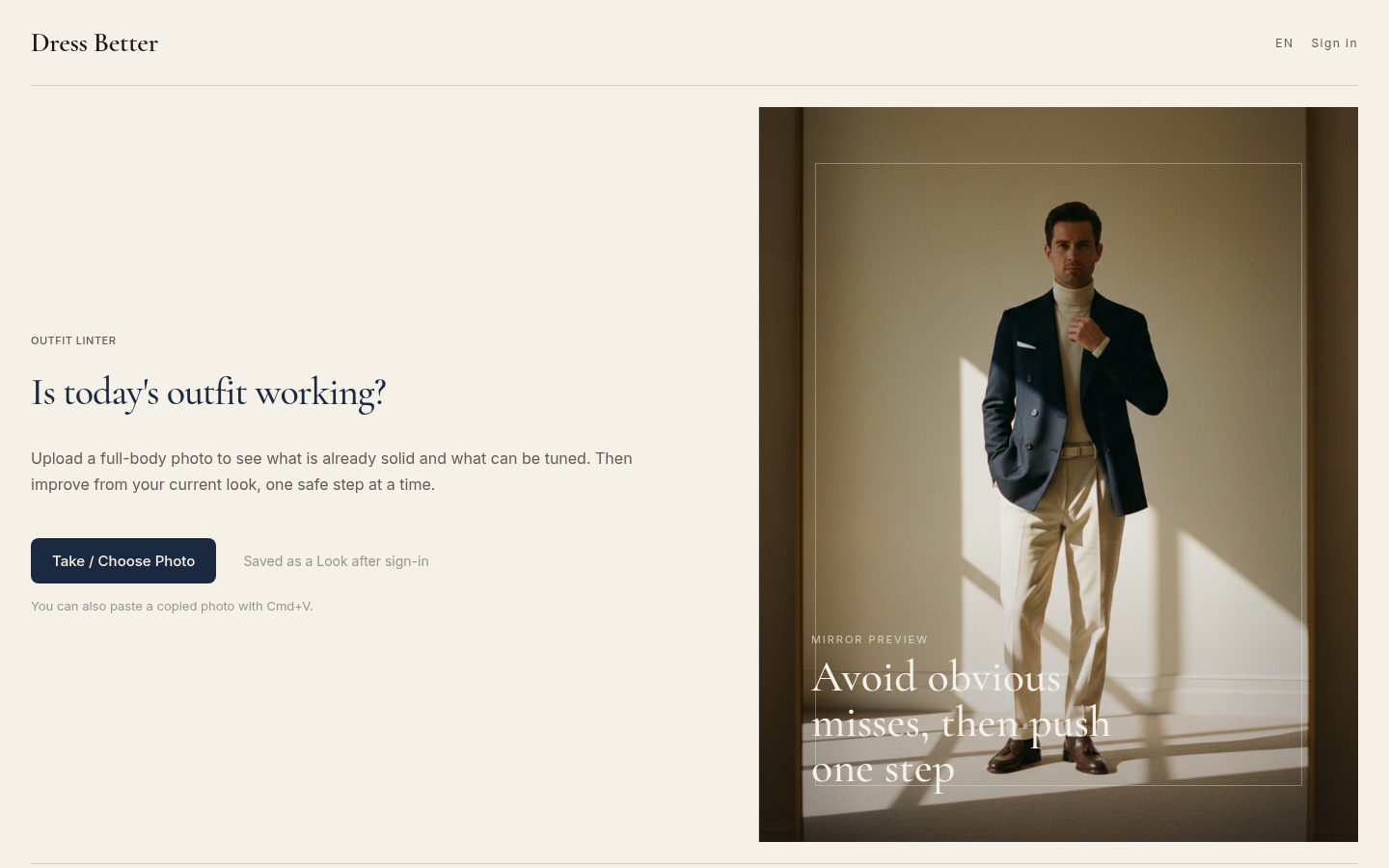
Desktop homepage first screen showing Outfit Linter eyebrow, "Is today's outfit working?" heading, Take/Choose Photo CTA button, and menswear editorial mirror preview image. Englis
The check itself is simple. Look at the photo at thumbnail size: if your eye lands on the element you meant to lead, the combination works. Then look at it at arm's length and check the specific point you set out to fix. If the problem is gone and nothing new appeared, wear it.
If two versions of the outfit are close, keep the simpler one. Simplicity survives daylight, movement, and the rest of the day better than a look that only works in a mirror.
Common mistakes that keep an outfit looking stale
Most stale-looking outfits trace back to a small set of habits, and each one is fixable without a purchase.
- Changing everything at once. You lose the ability to identify what worked.
- Buying a fix before trying a swap. The same money is usually better spent on tailoring.
- Ignoring the shoes. Footwear carries more of an outfit's read than any other single item.
- Wearing a piece that no longer fits. Sentiment keeps a jacket in rotation long after its shoulder line stopped working.
- Repeating one silhouette. If every outfit has the same length and volume, the wardrobe looks smaller than it is.
There is a real limit to this method. Restyling cannot repair damaged fabric, fix a size that is wrong at the shoulder, or make a summer fabric work in winter. Those are replacement and repair problems, and treating them as styling problems wastes time.
Follow-up questions about restyling without shopping
Most restyling problems come down to four situations: getting started, fixing a combination, adapting to an occasion, or deciding when repair beats replacement. Each answer below stands on its own.
Getting started
How long does it take to restyle an outfit? Plan 20 to 30 minutes for the first one and about 5 minutes once you know your levers. Most of the time goes into the baseline photo and the comparison, not the styling itself.
What if I have no style vocabulary? Describe the outfit in plain words instead: too short, too loud, too flat, too loose. Naming the problem in ordinary language is enough to pick the lever that fixes it.
How many pieces do I need to start? Eight to ten pieces that you actually wear, including shoes. A larger starting pile slows the audit down and adds combinations you will never use.
Making the combination work
How do I change my wardrobe style without buying clothes? Change the styling layer first and the color balance second. Shoes, outerwear, and accessories shift an outfit's mood faster than any other lever, and they are the pieces you already own.
Can accessories really change an outfit? A belt, a bag, or a pair of shoes changes the formality and the visual weight of a look more than most people expect. One well-chosen change at the edge reads as a different outfit.
How do I stop repeating the same combination? Photograph the combinations you like and keep a short list. Variety comes from sequence and contrast, not from new items.
Fit, comfort, and occasions
What if the restyled outfit feels uncomfortable? Change the lever, not the standard. Comfort problems usually come from a waistband, a shoulder, or a shoe; if you cannot adjust it, that piece belongs in the repair pile, not in the rotation.
How do I restyle the same clothes for different occasions? Move the formality dial with shoes, outerwear, and one structured piece. A blazer and a loafer push the same base toward work; a knit and a clean sneaker pull it toward the weekend.
Does this work for men's and women's wardrobes? Yes. The four levers — fit, color, proportion, and styling — describe how an outfit reads regardless of the section of the store it came from.
Repairs, limits, and when to buy
When is buying actually the right answer? When the problem is structural: a size that cannot be tailored, fabric that has worn through, or a gap the wardrobe genuinely cannot fill. Buying to solve boredom is the case that rarely works.
What do I do with clothes that are worn out? Try repair first — a cobbler for shoes, a tailor for seams, a brush and steamer for fabric. If the item cannot be brought back to a clean line, remove it from the rotation so it stops distorting your combinations.
Do I need a full-length mirror to restyle an outfit? A phone camera on a timer or a doorway mirror works. What matters is seeing the full line from shoulder to shoe, which a bathroom mirror usually cannot show.