What is a free outfit proportion checker?
A free outfit proportion checker is a tool that compares the lengths, volumes, and breakpoints in whatever you are wearing and points out which one is making the outfit read as unbalanced. Free versions exist because the core check is mostly arithmetic and rules — where your top ends, where your waistband sits, where the trouser hem lands, and how much shoe is visible — and that does not need a paid subscription to be useful.
Free tools usually fall into one of two shapes:
- Text or measurement checkers ask you to describe or enter a few outfit details, then return a short list of risk points and suggested tweaks.
- Photo-based analyzers take a full-body photo and rate the outfit across dimensions such as proportion, color, material, and occasion.
Both can answer the same core question. The difference is what you are willing to upload and how much detail you want back.
Key answers at a glance
- What does it measure? The visual length and volume relationships in your outfit, not your body itself.
- Is the free version enough? For a before-you-leave check on top length, waist, hem, and shoes, yes.
- What do you need to start? The full outfit assembled, including shoes, plus a full-length view in a mirror or a photo.
- How accurate is it? Rule-based checks are consistent but literal; photo-based checks are richer but depend on lighting, camera angle, and fabric drape.
- What can it not see? How the fabric actually moves, how the colors read in your light, and whether the outfit suits the occasion.
What a proportion check actually looks at
A proportion check looks at four or five horizontal breakpoints and the volume around them, with the goal of one continuous vertical line instead of a stack of competing lines. When a breakpoint sits at an awkward place, the eye reads the whole outfit as shorter, wider, or top-heavy — and that single breakpoint is usually the only thing that needs to change.
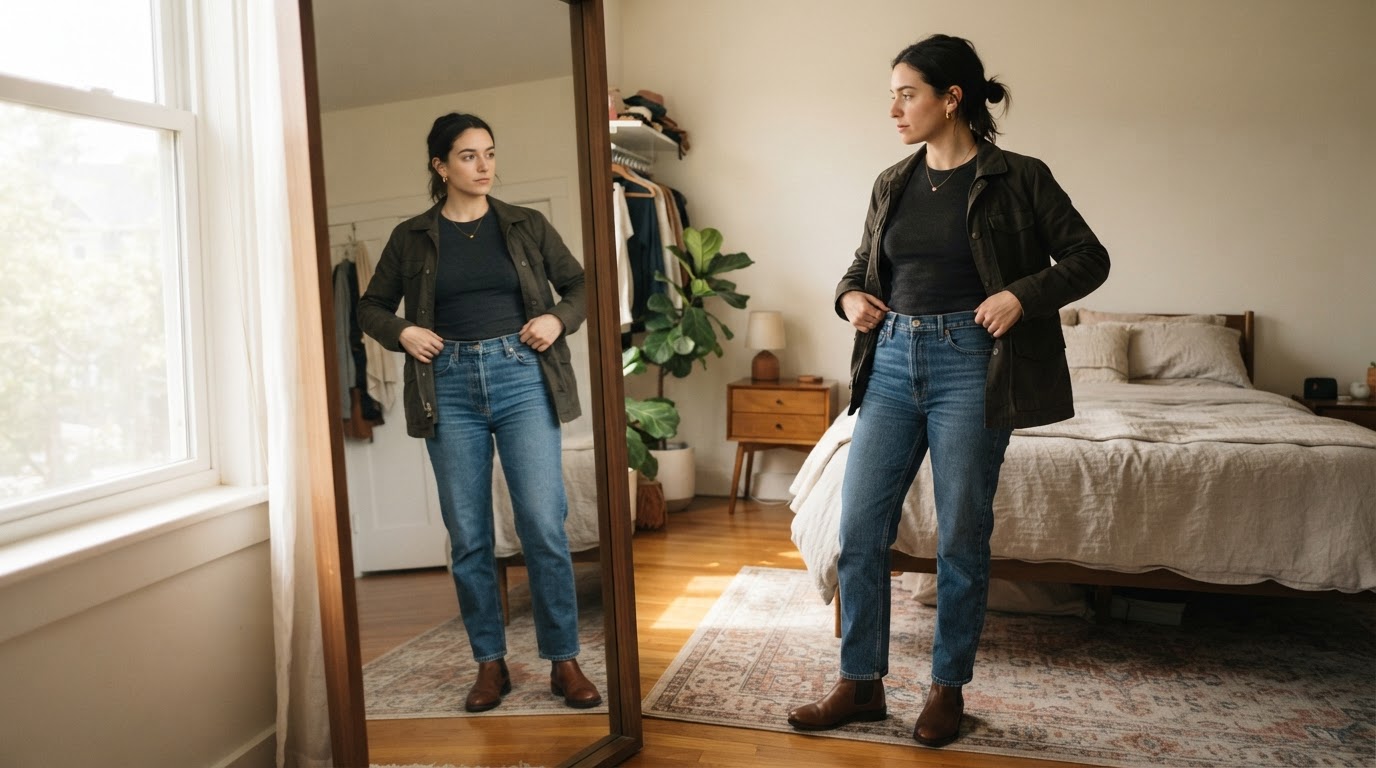
Most free checkers work through some version of this list:
Checkpoint | What it compares | What a balanced result looks like | Fast fix |
|---|---|---|---|
Top or jacket length | Where the hem lands relative to your waist and hip | Hem lands clearly above the waist or at the hip | Shorten the top, tuck it, or switch to a shorter cut |
Waistline placement | Where the waistband sits against torso length and leg length | One clear waist line instead of two competing ones | Try a higher or lower rise; align the belt with the waistband |
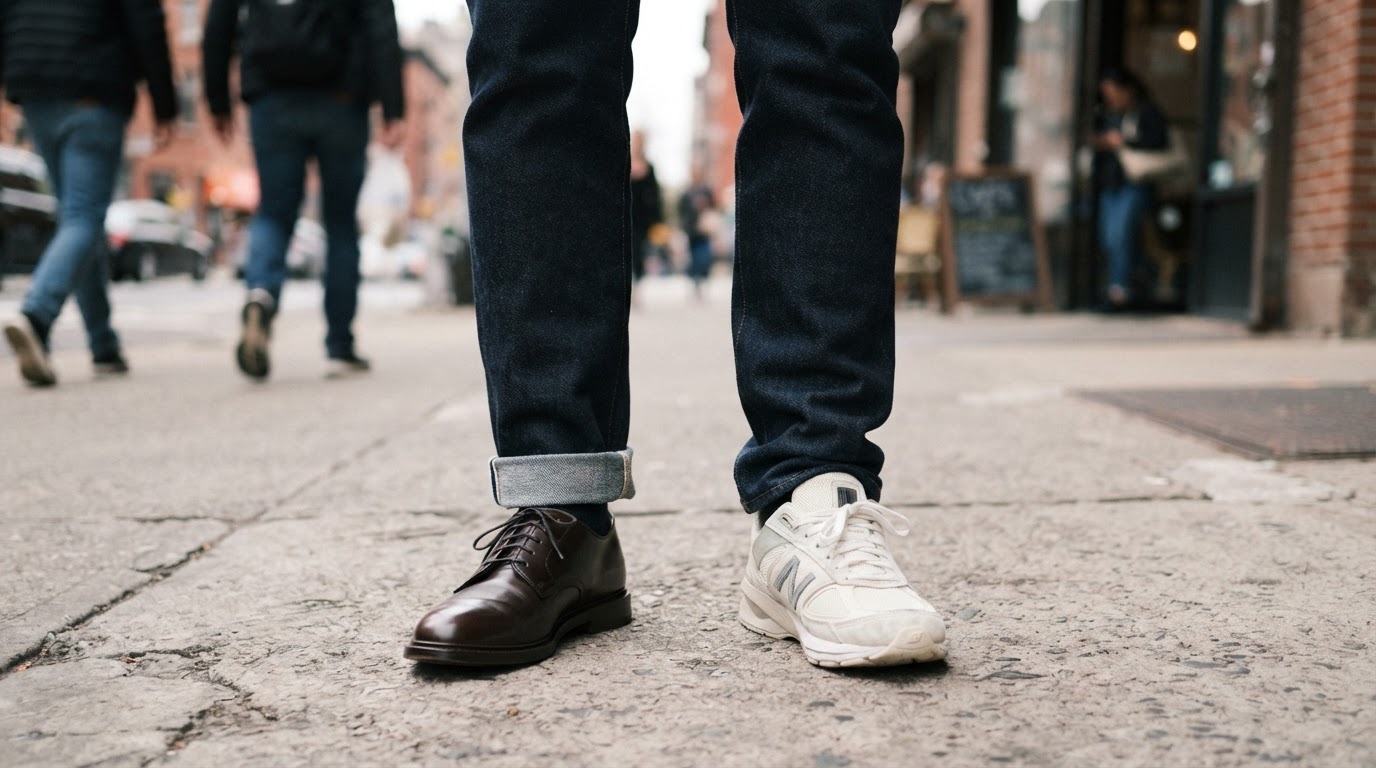
Trouser hem and break | Where the fabric ends against the shoe | One clean break, or a deliberate crop | Raise or lower the hem by the difference you see |
Shoe shape and volume | The visual weight of the shoe against the leg opening | Shoe volume matches the taper of the leg | Swap a chunky shoe for a sleeker one, or the reverse |
Shoulder line | Where the shoulder seam sits against your natural shoulder | The seam sits on the shoulder, not past it or inside it | Adjust the fit, or let the shoulder sit where it was cut |
None of these are absolute rules. They are comparisons: a wider leg changes how much shoe volume looks right, and a longer jacket changes how much hem you can show underneath. That is why the check is most useful when it hands you the single biggest mismatch instead of a score for every dimension.
How to use a free outfit proportion checker
Using a free outfit proportion checker takes about two minutes if you settle one thing first: whether you are checking an outfit you are already wearing or a plan you have not put on yet. The tool can only work with what you give it, so the quality of your input sets the quality of the result.
Before you start, have these ready:
- The full outfit assembled, including shoes — proportion problems often live in the hem and shoe relationship.
- A full-length view: a mirror, or a photo taken at chest height from a few steps back with the camera level rather than tilted.
- One or two specific annoyances, such as "the jacket feels long" or "the trousers pool at my ankle", so the checker has something concrete to confirm or rule out.
The steps:
- Pick the right tool type. If you have a full-outfit photo and want the broadest read, a photo-based analyzer catches more. If you would rather not upload anything and mainly want the length relationships checked, use a text or measurement checker.
- Enter the outfit honestly. Describe or submit what you are actually wearing, including the pieces you are unsure about. Leaving out the shoes or the belt removes a comparison the tool needs.
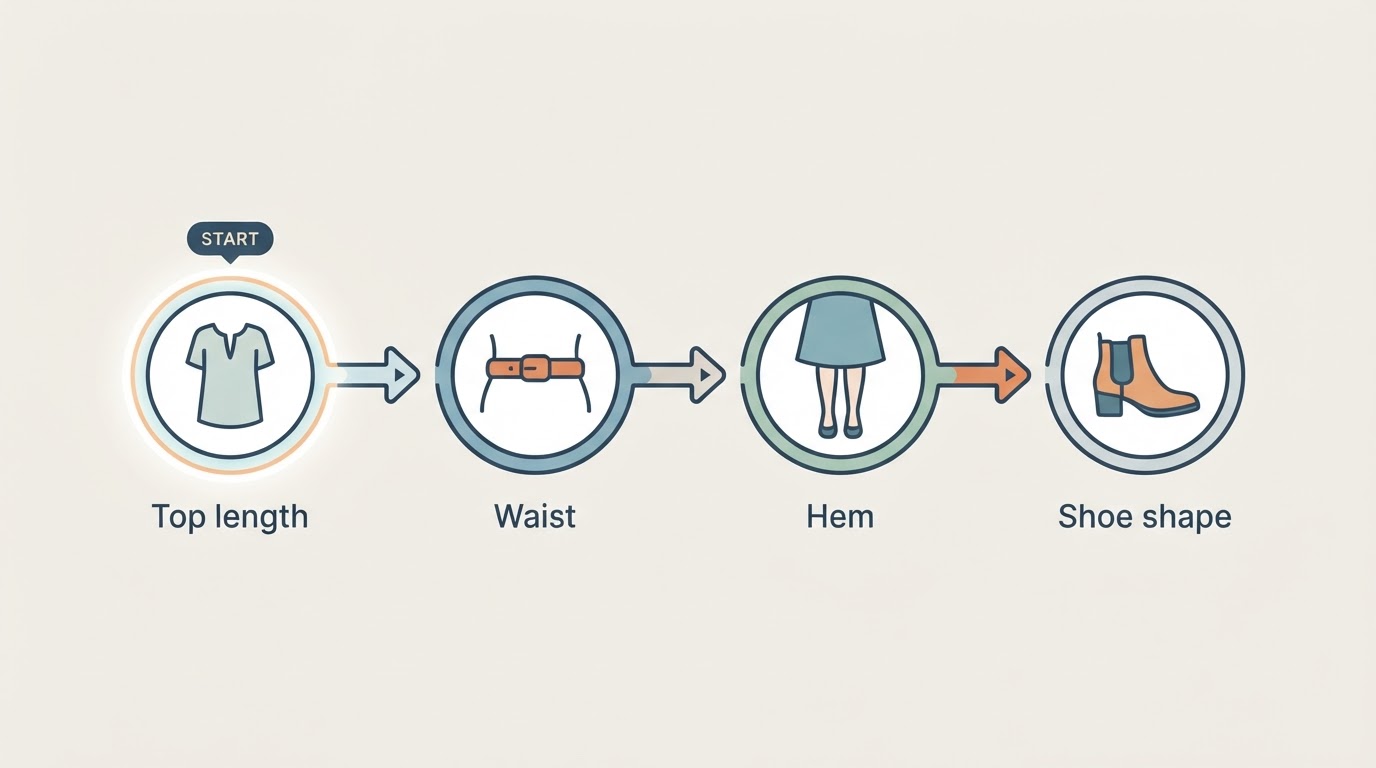
- Read the flagged checkpoint first. Most free tools return a small set of risk points. Start with the one that changes the silhouette, usually top length or waist placement, rather than the one that is easiest to change.
- Make one change and re-check. Change the flagged item, then run the same check again. A second mismatch that survives the first fix is real; a second mismatch that disappears was caused by the first.
- Stop when the lines agree. The completion standard is simple: top, waist, hem, and shoe form one continuous line when you step back and look. If they do, more adjusting is usually noise.
How to read the results without overcorrecting
The most common mistake with a proportion checker is reading it as a list of every possible improvement instead of a priority order. A tool that flags four things is not asking you to fix four things before you leave; it is showing you the order in which the fixes matter.
Keep these limits in mind:
- Texture and drape are invisible to text checks. A hem can measure correctly and still hang badly because of fabric weight, a stiff lining, or a crease that will not fall out.
- Lighting changes the read. Photos flatten depth and shift color, so a proportion that looks off in a dim hallway can look fine outdoors.
- Golden-ratio advice is a starting point, not a law. Familiar one-third and two-thirds guidelines describe a common balance point; your height, shoulder width, and the occasion can move that point in either direction.
- Occasion beats geometry. A deliberately oversized jacket or a cropped trouser can be exactly right for the setting even when a rule-based check flags it.
- One fix per pass is faster than five. Every change alters the other relationships, so changing several things at once makes it impossible to tell which one worked.
If a checker keeps flagging the same checkpoint no matter what you change, the cause is usually the cut of the garment rather than the styling. At that point the useful move is to leave the outfit as it is, note the pattern, and look for a different cut next time. That is a finding, not a failure.
Text-based checkers vs photo-based analyzers
Text-based checkers are faster and more private; photo-based analyzers see more of the outfit but ask more of you. Both can answer a free outfit proportion question, so the choice comes down to which trade-off you prefer on a given morning.
- Text-based checkers work from your description or a few inputs. They return a result instantly, they usually need no account, and nothing leaves your device when the logic runs in the browser. They are strongest on the mechanical relationships: top length, waist placement, hem, and shoe shape.
- Photo-based analyzers work from the image. They can also read color harmony, fabric impression, and overall silhouette, and they often summarize the result as a score with a small number of suggested adjustments. In exchange, you have to take a usable photo, and the read depends on camera angle and light.
One example of the text-based kind: Dress Better offers a free set of browser-based text checkers that includes a proportion checker described as reviewing top length, waistband placement, trouser hem, and shoe shape, then returning risk points and a short list of priority tweaks. The same toolset says its checks run in the browser rather than on a server, and it points to photo-based analysis when the question depends on how a fabric actually hangs. Treat it as one concrete option — the right checker is the one whose inputs you will actually fill in.
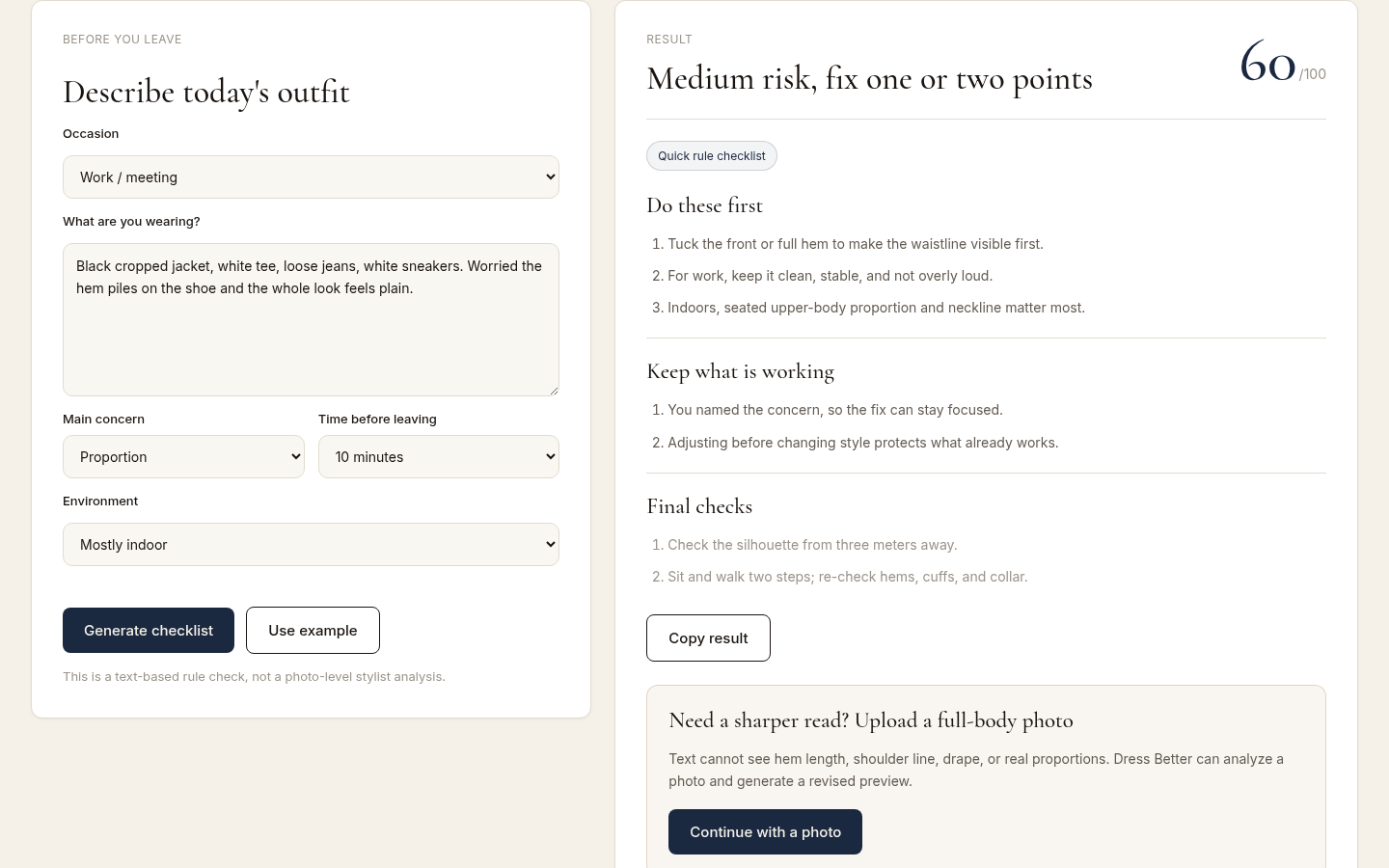
After submitting example outfit description. Shows 'Medium risk, fix one or two points', 60/100 score, 'Do these first' and 'Keep what is working' actionable lists. en-US.
Follow-up questions after the first check
These are the questions that usually come next, grouped by when they appear.
Before you run a check
Do I need my exact measurements?
No. Most free proportion checkers work from relative lengths and a description of the outfit. Exact measurements help only when the tool asks for them or when you are hemming a garment.
Can I check an outfit I have not worn yet?
Yes, as long as you can see the pieces together. Lay them out or hold them against yourself in front of a mirror; the length relationships are what the check compares.
Is a free checker less accurate than a paid one?
Not on the core proportion relationships. Paid tiers usually add photo analysis, saved history, or more detailed feedback rather than a different set of length rules.
While you are checking
Which checkpoint should I fix first?
The one that changes the silhouette. Top or jacket length and waist placement come before hem and shoe details.
What if two checkpoints conflict?
Fix the higher one first. Changing top length or the waist line changes how much hem and shoe volume looks right underneath it.
How do I photograph an outfit for a photo-based checker?
Use a full-length frame, hold the camera around chest height, keep it level, and stand in even light. Tilted or close-up photos distort the lengths the tool is trying to compare.
After you get a result
Why does the checker keep flagging the same thing?
Repeated flags usually point to the cut of the garment rather than how you are wearing it. Note which checkpoint recurs and look for a different cut in that piece.
Should I follow every suggestion at once?
No. Apply the first fix, re-check, and stop when the main lines agree. Turning every suggestion into a change usually makes an outfit look more deliberate than it needs to and less like you.
Can a proportion checker tell me if an outfit suits the occasion?
Only roughly. Some tools include an occasion check, but dress codes and context are things you know better than any length rule does.
Bottom line
A free outfit proportion checker is worth using when you treat it as a priority list rather than a report card. Check top length, waist placement, hem, and shoe shape in that order, change only the first mismatch, and re-check once. If the outfit still reads as one continuous line, you are done — and if the same checkpoint keeps coming back, the useful answer is a different cut, not a longer adjustment session.