Rate My Outfit Before Work in Four Steps
The fastest reliable way to rate an outfit before work is a mirror photo plus a fixed four-point check.
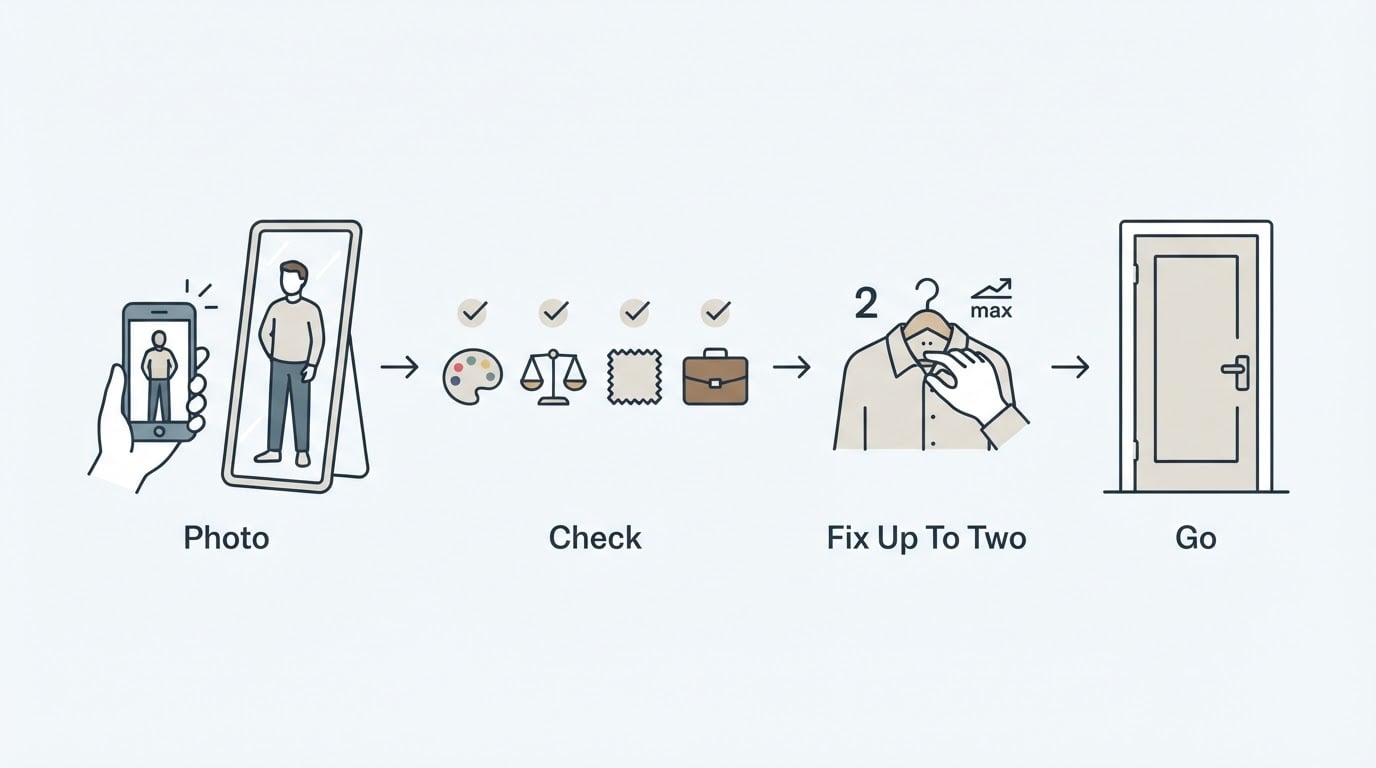
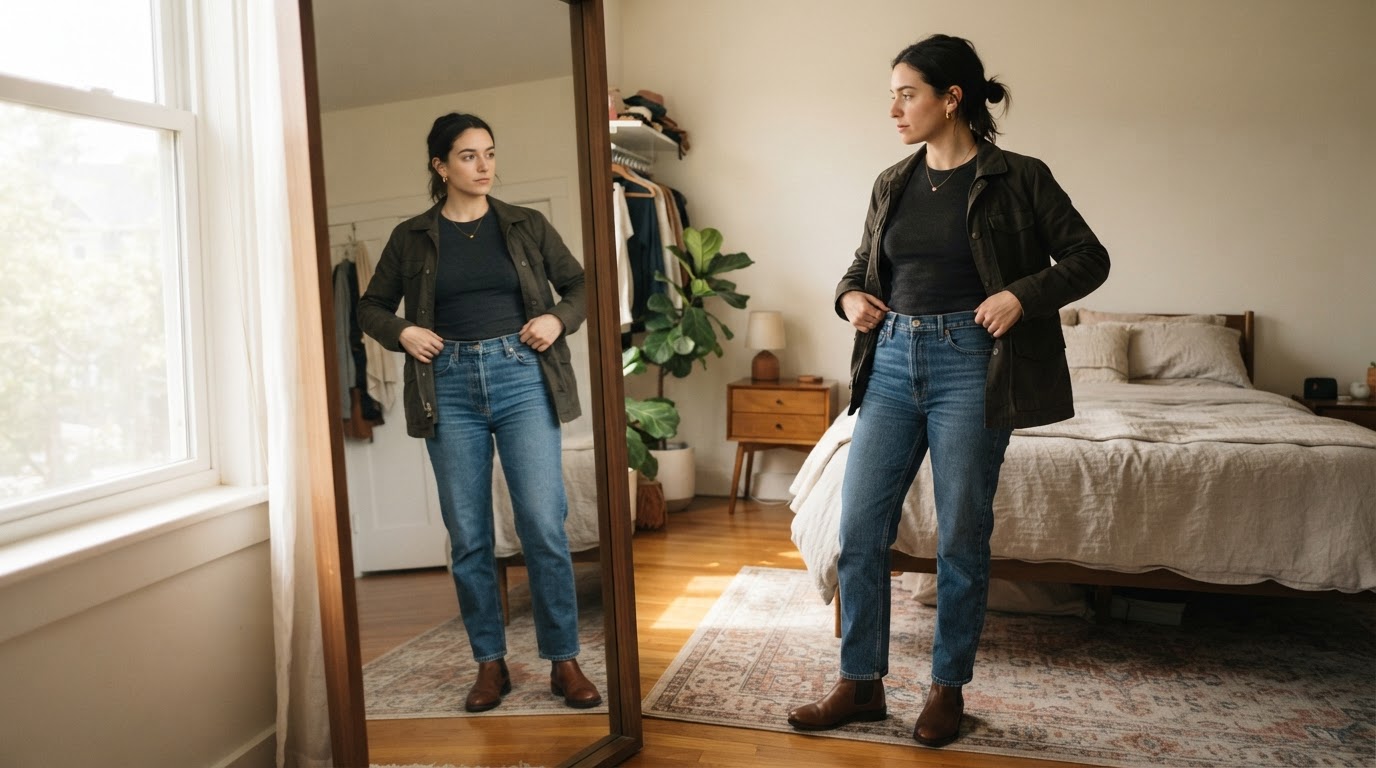
- Photograph the whole outfit. Stand in front of a full-length mirror and take one photo that includes your shoes. Daylight or even indoor light shows color and texture better than a dim hallway.
- Check four things, in order. Color harmony, proportion, material condition, and occasion fit. Using the same order every time keeps a rushed judgment from turning into a mood judgment.
- Name what already works. A rating with only complaints is not a rating. Say the two things you are keeping — the jacket line, the shoe color — so you do not "fix" the parts that were carrying the outfit.
- Fix at most two conflicts. Two small changes, such as a belt, a tuck, or a different pair of shoes, usually move an outfit more than a full re-dress, and they fit inside a morning.
If you are already dressed and short on time, the four-point check alone takes less than a minute.
Key Answers at a Glance
How long should rating your outfit take? Under a minute when you use the same checklist every time; longer only when you are choosing between two complete outfits.
What should a rating produce? Two outputs: what to keep and what to change. A number with no reasons cannot guide either decision.
How many changes are worth making? Two. A third change usually means you are rebuilding the outfit, which is a decision for the night before rather than the ten minutes before work.
How do you score an outfit out of 10? Score four dimensions — color, proportion, material, and occasion — then average them. The single number is a summary; the four dimensions are the useful part.
Is a free outfit rating worth using? Yes, when it shows its criteria. Free photo raters and in-browser checkers can give a consistent first opinion; a rating that hides how it was reached is entertainment.
Do you need to upload a photo? Not always. Rule-based checkers can work from a short written description, while photo-based AI scoring needs the image to be processed.
What an Outfit Score Out of 10 Actually Measures
A score out of 10 is useful only when you know which dimensions produced it.
Most practical rubrics break an outfit into four questions:
- Color: Do the tones agree, with at most one clear accent? Two strong colors competing for attention read as noise.
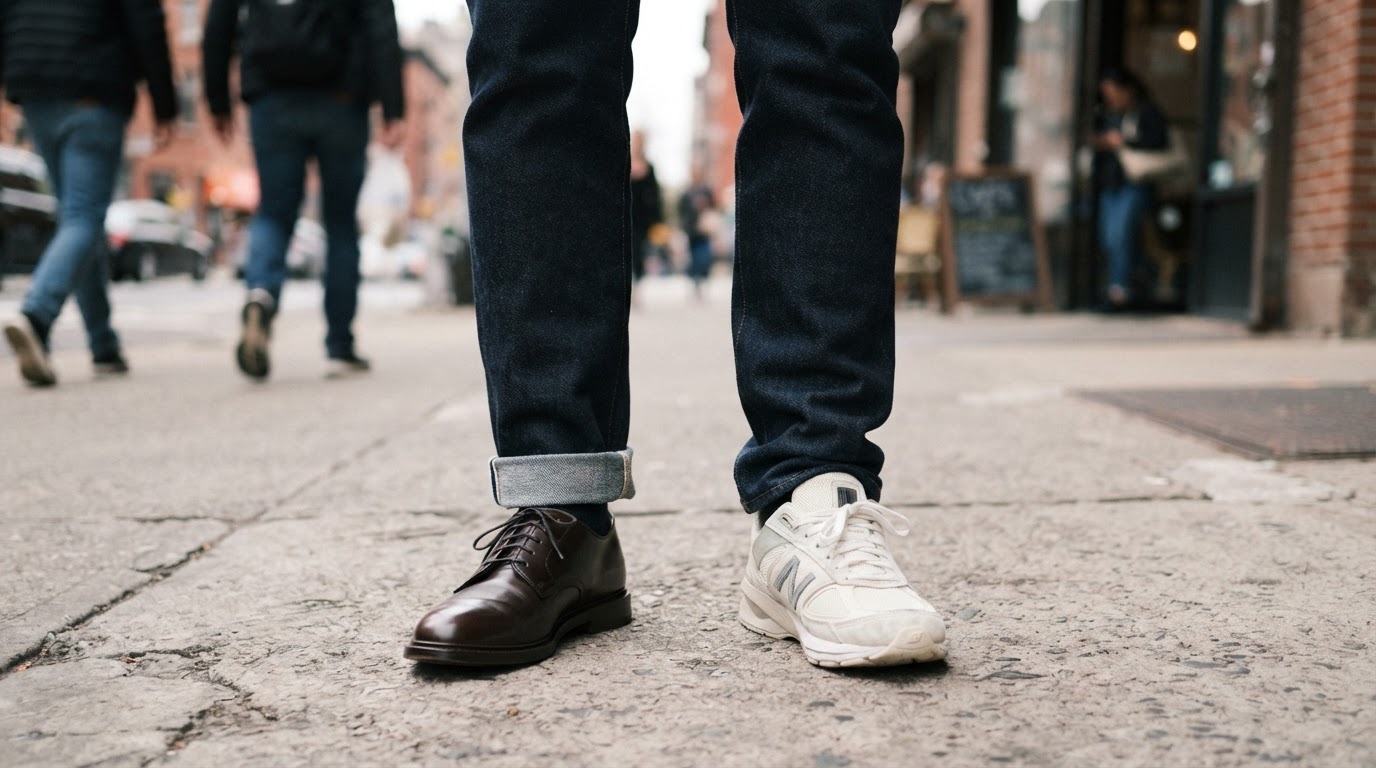
- Proportion: Do the lengths relate — top to bottom, hem to shoe, jacket to torso? A break in proportion is visible even when every individual piece is good.
- Material: Do the fabrics sit at a similar level of formality and finish? A crisp shirt against a tired knit creates a conflict you can feel without naming.
- Occasion: Would this outfit be unremarkable in the room you are walking into? Slightly underdressed reads as careless; slightly overdressed usually reads as intentional.
Score each dimension from 1 to 10 and average them. Three honest scores beat one global impression, because they show where to spend your two fixes. If you would rather work on a 0–100 scale, keep the same dimensions and the same weighting. Consistency matters more than the maximum.
One warning: mood inflates scores in the morning and deflates them at night. Rate the outfit you see in the photo, not the morning you are having.
How to Photograph Your Outfit for an Accurate Rating
An accurate rating starts with a photograph that shows the outfit, not a flattering angle.
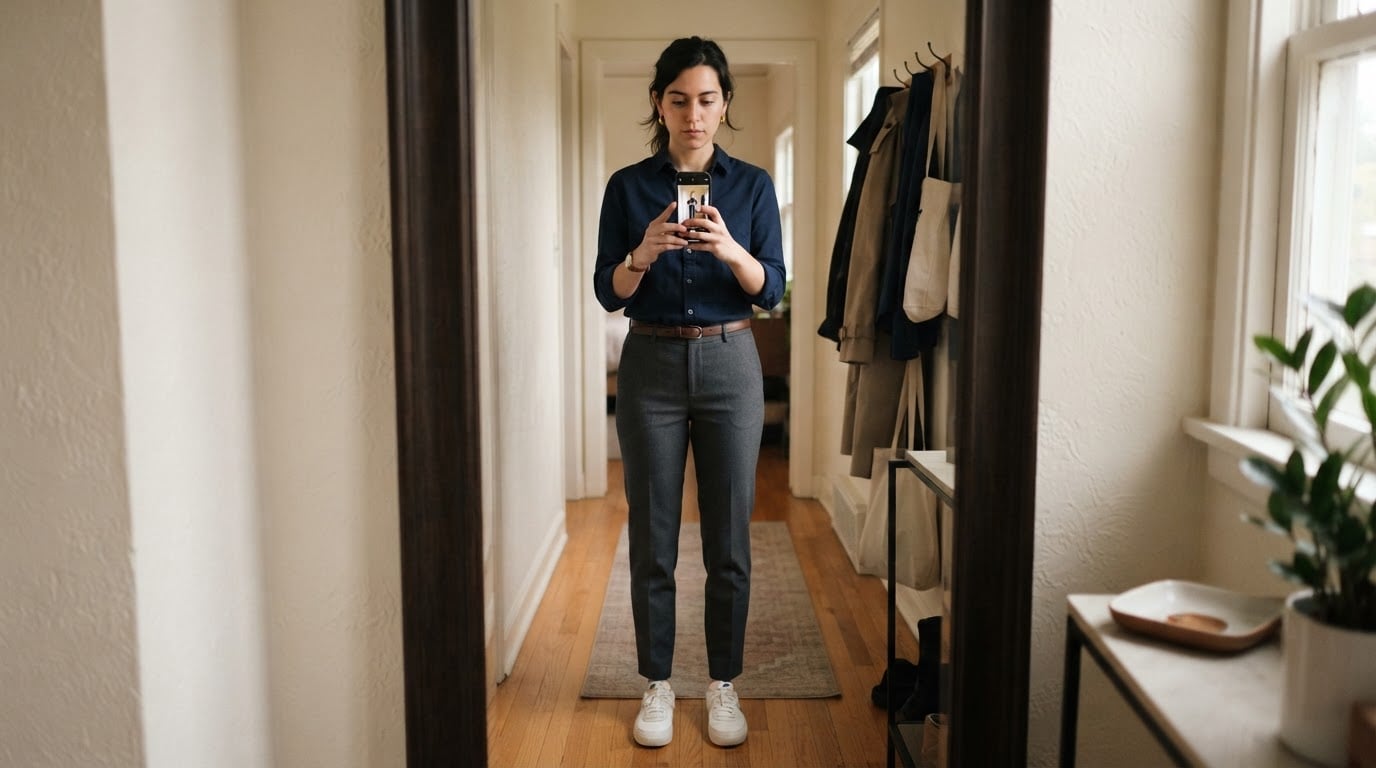
- Full body, shoes included. Cropping at the ankle removes the shoe-to-hem relationship, which is one of the most common sources of proportion problems.
- Neutral light. Stand near a window or in even indoor light. Warm bulbs shift color enough to create a conflict that is not in the clothes.
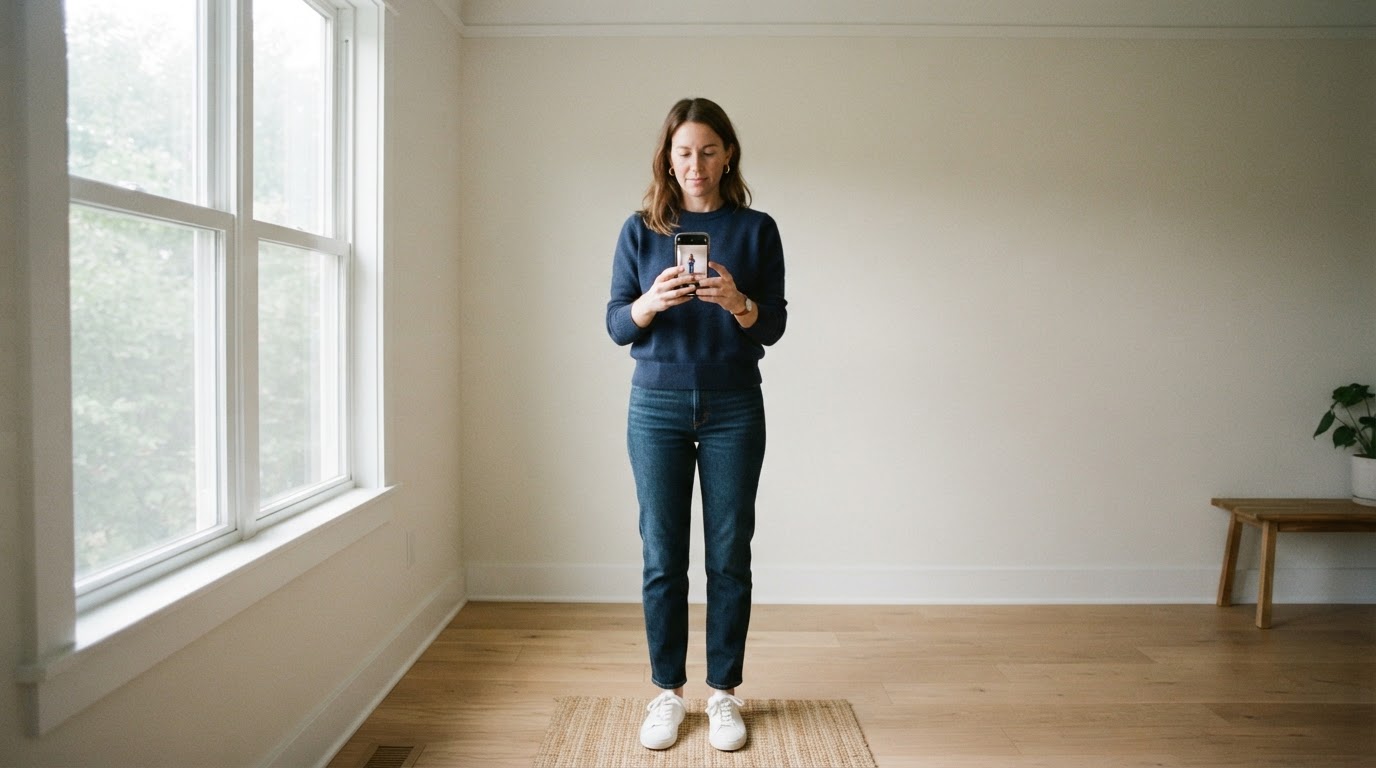
- Straight posture, phone at chest height. Hold the phone level and stand naturally. A tilted camera changes how long your legs look and how long your jacket looks.
- Front view, then one turn. The side view reveals whether layers sit flat and whether the jacket length works with the trouser rise.
- No filters, no edits. Any correction the camera applies also corrects the thing you are trying to evaluate.
If you use a photo-based tool, check its file requirements before you shoot. Some tools accept JPEG, PNG, WebP, HEIC, or HEIF files up to roughly 10MB, and a plain, well-lit photo usually evaluates better than a stylized one. The goal is a boring, accurate picture of the clothes.
AI Raters, Human Opinions, and Your Own Eye
Each way of rating an outfit answers a slightly different question, and the fastest reaction is rarely the most useful.
Social media and TikTok comment threads. A posted outfit gets reactions in minutes, which is useful for a social read and weak for a work read. Comments reward what photographs well and rarely name which dimension is causing the problem. If you ask a crowd, ask for one specific thing: "Is the jacket too long?" gets a usable answer, while "rate this" invites noise.
Photo-based AI raters. A photo rater applies the same criteria on every run, which is exactly what a rushed morning needs. The trade-off is that a photo-based service usually needs the image uploaded or processed remotely, so check how a tool handles your photo before using one you would not post.
Chat assistants. A general chat assistant such as ChatGPT can give a structured opinion if you describe the outfit in words — colors, garments, fit, and where you are going. That works well for naming conflicts, and it cannot see proportion the way a photo can. Treat the answer as a second opinion on your description, not as a visual review.
Your own eye plus a checklist. This is the fastest and most private option, and the only one that improves with practice. Its weakness is bias: without fixed criteria, you will score what you already like as high.
The useful pattern is to combine two of these. Run the quick self-check first, then get one objective opinion only when the self-check is genuinely split.
What Dress Better's Rate My Outfit Tool Does
Dress Better is a web app built around a clothing-linter idea: you photograph or paste a full-body outfit and get feedback on color, proportion, material, and occasion instead of general praise.
Within that app, Rate My Outfit is the compact, free scoring mode. According to the product's own description, one full-body photo returns:
- a 0–100 style total, with a sample panel showing a score of 82;
- separate dimension scores such as proportion 76, color 88, and polish 72;
- a one-line read of the outfit; and
- the two smallest adjustments worth making.
The tool does not ask for height, weight, or style preferences; the description frames it as reading the relationships between the clothes rather than rating the body. Uploads are described as accepting common image formats up to about 10MB, with a full-body mirror photo that shows your shoes recommended for the clearest result. The app also saves each check so you can compare how a look scores on repeat wear and notice issues that keep coming back.
If you would rather not upload a photo at all, the same site offers lighter text-based checkers that run in the browser, and a Pro subscription appears at checkout for users who want the fuller workflow. For a before-work decision, the free scoring mode is the part that matters: it answers the same four questions you would ask in the mirror, in a fixed order.
The Smallest Fixes That Change the Most
Most before-work improvements are small, and they cluster in the same few places.
One color conflict. If two tones are close but not equal — a black tee under a navy jacket, for example — separate them deliberately or unify them. Swapping one accessory is usually enough.
A proportion break. If the top ends at the widest point of the trouser, or the jacket stops at the wrong hip line, adjust the tuck, the sleeve roll, or the shoe height. One adjustment restores the line.
A material mismatch. If one piece looks slept-in next to a crisp piece, steam it or change the layer. Fabric condition is often the difference between "intentional" and "rushed."
An occasion gap. If the outfit is one level off for the room, add structure — a collar, a belt, a cleaner shoe — rather than changing everything.
Pick the first conflict you notice and the most visible second one, then leave the third alone. The point of a before-work rating is a decision, not a renovation.
What to Do With the Score Before You Leave
Treat the score as a decision filter, not a grade.
- 7 or above: keep the outfit and go. Re-checking a good outfit usually makes it worse.
- 5 to 6: make the two smallest fixes, look once more, and leave. Do not reopen the wardrobe.
- Below 5: change one structural piece — the jacket, the trousers, or the shoes — and re-run the check once. If you are out of time, choose the outfit with the strongest occasion fit and accept the rest.
Frequently Asked Questions
Can I rate my outfit online for free?
Yes. Free photo-based raters and in-browser checkers cover the basic four-point check, and Dress Better's Rate My Outfit mode is described as free to use. Paid tiers usually add history or a deeper workflow rather than a different definition of what looks good.
Is there an app that rates your outfit?
App-store raters and web apps both exist. A web app avoids an install and usually works with a photo you have already taken; an app can add saved history and reminders. Check whether the photo is uploaded before you choose.
Can AI rate my outfit from a photo?
It can produce a consistent score and name conflicts, which is what you want in the morning. It cannot know how you feel in the clothes, and it can judge only what the photo shows, so the quality of your input limits the quality of the rating.
Can ChatGPT rate my outfit?
A general assistant can evaluate a description: the colors you are wearing, the fit, the fabrics, and the occasion. That is useful for spotting conflicts in words, but it does not see proportion, so it works best as a second opinion.
Do I have to upload a photo?
No. A mirror and a fixed checklist are enough. Uploading a photo buys you an automated second opinion and a saved record of the outfit.
How do I rate my outfit out of 10 without any tool?
Score color, proportion, material, and occasion from 1 to 10, average the four numbers, then note one thing to keep and two things to fix. Repeat the same four scores for a week and your weakest dimension usually becomes obvious.
What to Avoid When Rating Your Outfit Before Work
Most bad morning ratings come from four mistakes.
- Rating the body instead of the clothes. The outfit either works or it does not; self-criticism is not feedback and cannot be fixed with a belt.
- Making more than two changes. Past two, you are designing an outfit rather than checking one — and the clock is against you.
- Judging in bad light or in a hurry. Both produce false negatives, and a false negative at 7:45 a.m. turns into an unnecessary change.
- Confusing flattery with accuracy. "It looks fine" and "it looks right for the room" are different statements. Prefer the second.
A rating you can act on in a minute is worth more than a perfect one you never finish.