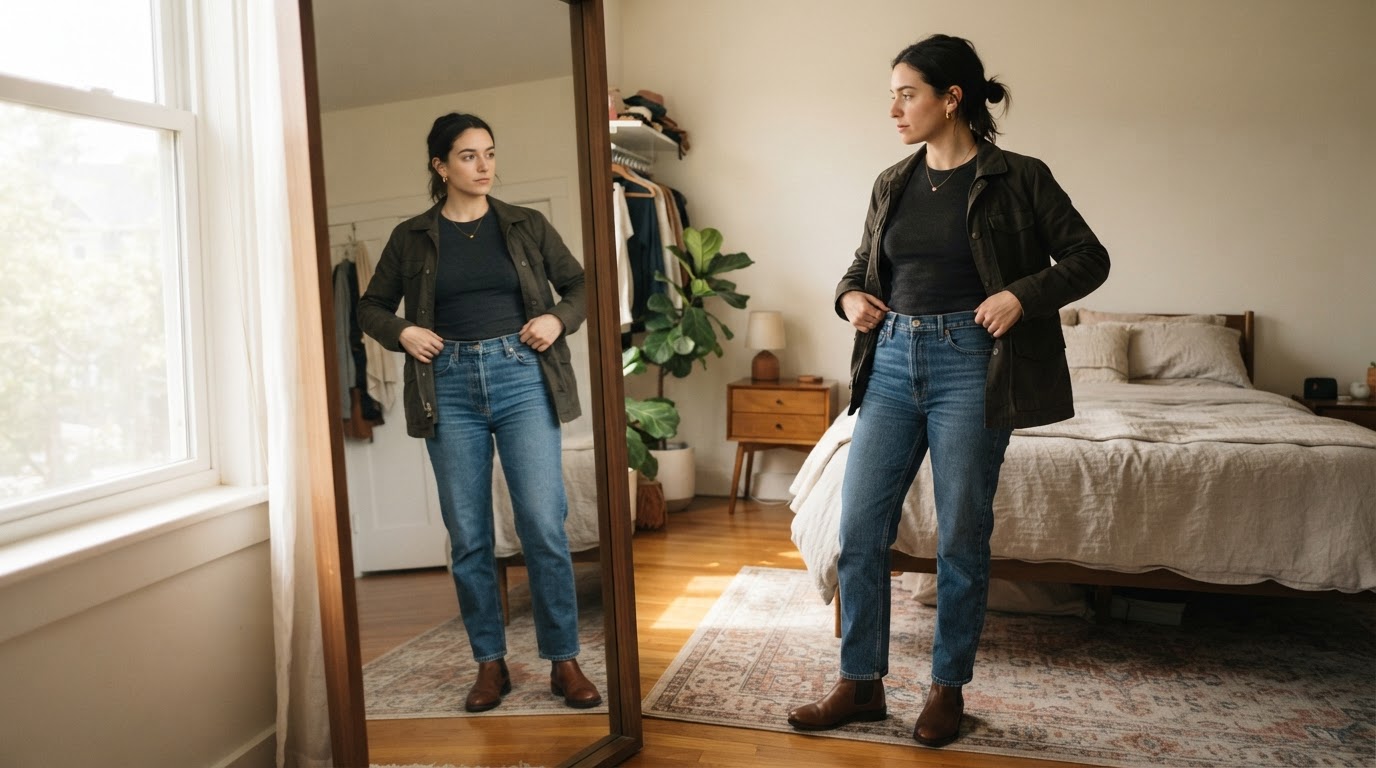
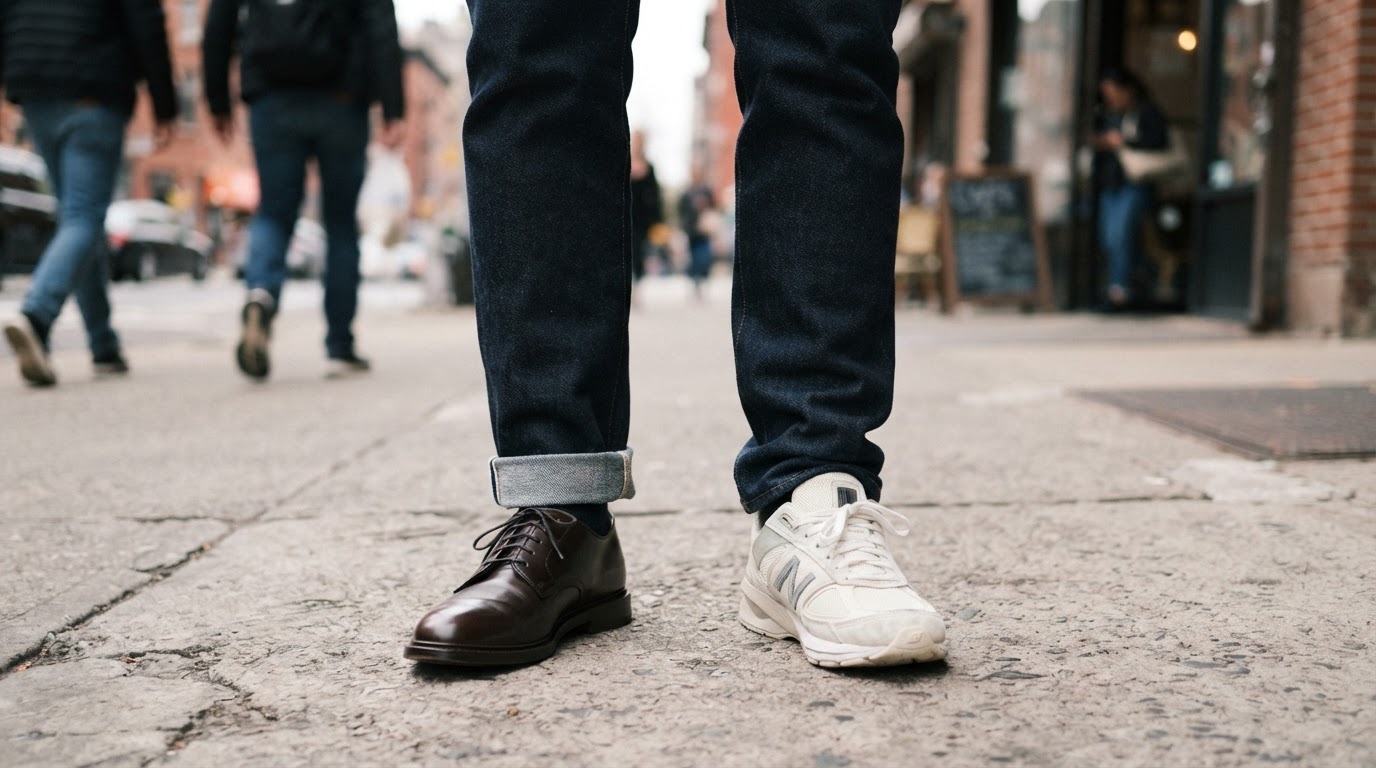
The 60-second check: four things to look at
Give yourself one minute and check four things: daylight, color count, dominance, and contrast. Everything else is detail, and none of it requires a color wheel.
The short version:
- Safest single color: navy or charcoal.
- Safest combination: one dark neutral, one light neutral, and one small accent.
- Skip in large areas: bright red, orange, neon, and busy multi-color prints.
- Fastest check: a full-body photo in daylight, then count the color families you can see.
- If you change only one thing: make the shoes and the belt agree.
Then run the check in order:
- Stand in daylight. Fluorescent and warm indoor bulbs shift color, so a mirror that flatters an outfit under one bulb can mislead you about the same outfit in a lobby.
- Count the color families. Base, support, and accent should total three or fewer. If you can see five distinct colors, the outfit is competing with itself.
- Find the dominant color. One color should cover roughly 60 percent of what you are wearing, a supporting tone around 30 percent, and an accent no more than 10 percent. If every piece is the same size, nothing leads.
- Check the contrast. Compare the lightness of your top and bottom. Navy trousers with a navy shirt and navy shoes read as a uniform; the same trousers with a white or light-blue shirt read as an outfit.
- Zoom in on the noise. Shoes, belts, bags, watches, scarves, and pocket squares are small, but they are the pieces most likely to add a fourth or fifth color.
You are finished when you can name the base, the support, and the accent out loud, and none of them surprises you.
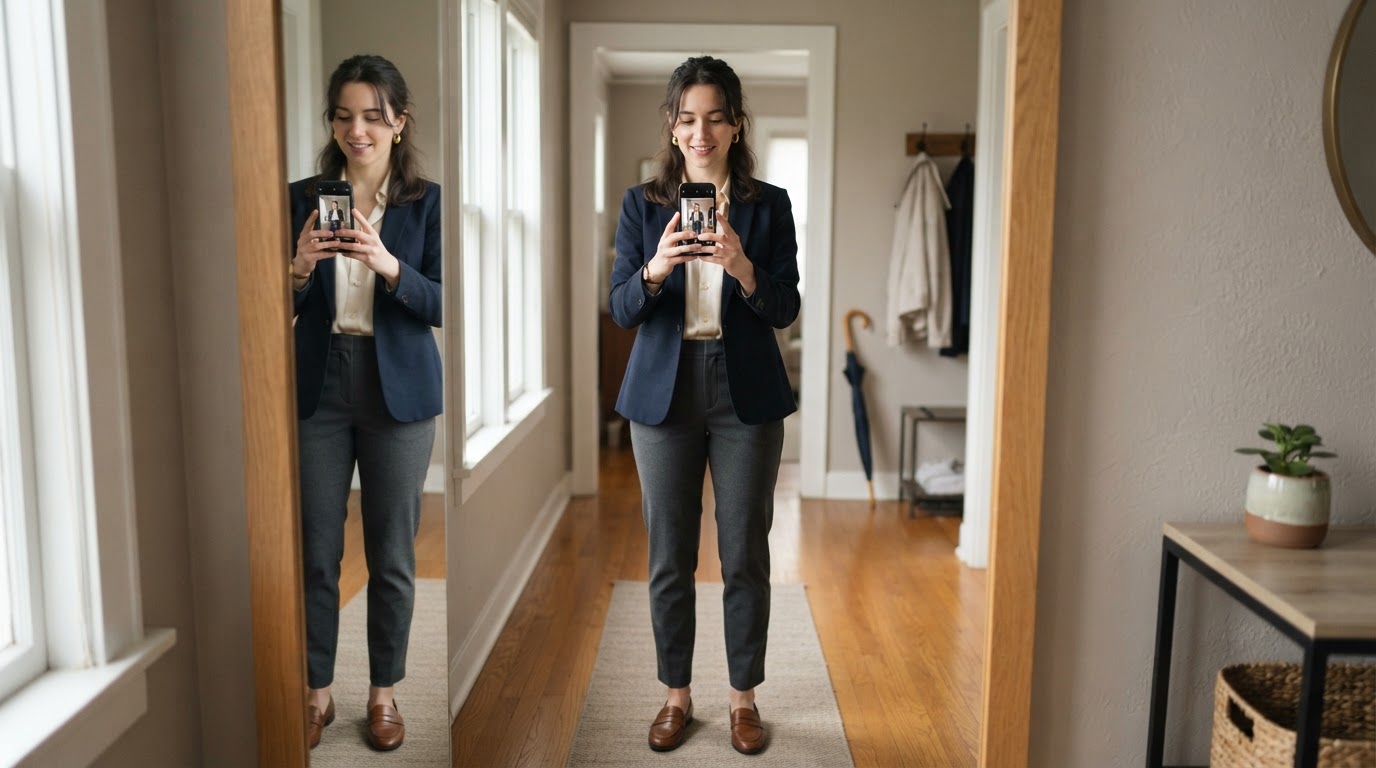
The safe interview palette
Navy, charcoal, gray, black, white, and light blue are the colors that consistently read as professional. Build around them and you will rarely be the worst-dressed person in the room.
A simple mapping:
- Suits and blazers: navy, charcoal, medium gray, black.
- Shirts and blouses: white, light blue, soft cream, pale gray.
- Trousers and skirts: the same neutral as the jacket, or one shade lighter or darker.
- Shoes: black, dark brown, or oxblood, with the belt matched to the shoe.
- Accents: one color, kept small, ideally in a tie, scarf, or pocket square.
Bright colors are not forbidden, but they are expensive to wear: a red tie on a navy suit is a classic accent, while a red shirt under a gray suit pulls attention to your chest instead of your face. Let the neutral do the work.
What color to wear to an interview, by setting
Match the palette to the formality of the workplace, not to your favorite color. The more conservative the industry, the narrower the safe range.
- Finance, law, government, consulting: navy or charcoal suit, white shirt, dark shoes, and a quiet tie. Black is acceptable in the most formal rooms.
- Business casual offices: a navy or gray blazer with chinos or tailored trousers in stone, olive, or khaki, plus a white or light-blue shirt and clean leather shoes.
- Tech, startups, and creative roles: still start from a neutral base. A dark sweater over a collared shirt in navy, gray, or black reads as capable without looking overdressed.
- Retail, food service, and other uniform-adjacent jobs: a plain, clean shirt in white, light blue, gray, or navy with dark trousers and closed shoes. Skip the suit; neatness is the signal.
- Video interviews: treat the visible frame as the whole outfit. A solid mid-to-dark top reads better on camera than a fine stripe that shimmers.
Women, men, and teens: the same colors, different pieces
The color rules do not change with gender or age; only the pieces do. Choose the neutral base first, then pick garments that fit your body and the role.
- Women: a blouse with tailored trousers, a sheath dress with a blazer, or a knit top with a skirt all work when the palette stays neutral. Keep your metals consistent, since an all-gold or all-silver watch, earrings, and necklace set reads more deliberate than a mix.
- Men: a suit or a blazer-and-trouser combination in navy, charcoal, or gray, a white or light-blue shirt, and a tie darker than the shirt. Fit matters more than price; a well-fitting jacket beats a loose expensive one.
- Teenagers: a full suit is not required. A clean button-down or plain top in white, light blue, or gray with dark trousers or a knee-length skirt, plus closed shoes, satisfies almost every interview. Borrow or thrift before you buy.
Whichever set you choose, the three checks stay the same: count the colors, find the dominant one, and confirm the shoes and belt agree.
Interview color psychology: what the conventions claim
Blue is the most commonly recommended interview color, black signals formality, and gray reads as balanced. Treat these as conventions rather than guarantees, because research on color and hiring is mixed and no shade will outrank preparation, fit, and cleanliness.
- Blue: trust, calm, and competence. A safe accent and a common shirt or tie color.
- Black: authority and formality. Strong in senior, creative, and evening-adjacent settings; it can read severe in a casual one.
- Gray and charcoal: balanced, analytical, and low-risk. The easiest neutral to combine.
- White: clarity and cleanliness. A white shirt is the default when nothing else feels right.
- Brown and tan: approachable and warm. Fine in business-casual rooms, less so in the most conservative ones.
- Red: attention and power. A small red accent can look confident; a large red area can look aggressive.
- Orange, yellow, green, and purple: harder to place in a first interview. Use them as small accents or save them for after you have the job.
The practical takeaway from color psychology is modest: pick the convention that matches the room, then spend your remaining effort on fit.
The color mistakes that make an interview outfit look off
Most interview outfits look off because of small color conflicts, not bad clothes. Fix the conflict and the same outfit suddenly works.
- Too many color families. A blue shirt, a green tie, brown shoes, and a patterned jacket each work alone, but together they split attention four ways.
- No contrast. A light shirt, light trousers, and light shoes blur into one shape. Darken one end of the outfit so the eye has somewhere to land.
- Competing accents. A bold tie, a patterned pocket square, and a metal watch can each be fine; all three at once fight for the same space.
- Mixed metal tones. Gold buckles with silver jewelry is a small mismatch that reads as a mistake, especially in a close-up handshake.
- Warm and cool dressings in one look. A cream shirt under a cool gray suit can turn slightly yellow next to the jacket, even though both pieces look fine alone.
- Pattern stacking. A striped shirt, a checked jacket, and a textured tie fight for the same attention. Keep one pattern and let the rest stay solid.
- Lighting that lies. Colors change under different bulbs, so match the outfit in daylight before you commit to it.
The four-point check to run before you leave
Run four checks in order and stop as soon as one fails: count, rank, contrast, noise.
- Count: three color families or fewer.
- Rank: one color clearly dominant, one supporting it, one accent.
- Contrast: a visible lightness difference between the lightest and darkest piece.
- Noise: remove one accessory if it competes with your face.
Your completion standard is simple. If you can describe the outfit in one sentence, base, support, accent, and nothing pulls your eye away from your face, you are done. If a check fails, change the smallest item first: a tie, pocket square, scarf, or bag, not the whole outfit.
How to check colors from a photo
A photo check catches what the mirror misses because it freezes the entire outfit in one frame. Take the photo in daylight, then look at it on a different screen than the one you used to shoot it; a single screen can hide a clash.
If you want a second opinion, Dress Better's free Outfit Color Checker is built for exactly this errand. Instead of teaching you the color wheel, it runs a photo-based color pass on the outfit you are already wearing and leads with color, covering harmony, contrast structure, and whether details such as shoes, a bag, jewelry, or an outer layer are adding noise, while still reporting proportion, occasion fit, and polish so that a color fix does not break the rest of the look. According to the tool's own description, it reuses the app's outfit-photo analysis and accepts JPEG, PNG, WebP, HEIC, and HEIF files up to 10MB. If you would rather not upload a photo, its text-based color matcher runs in the browser and asks you to describe the colors instead.
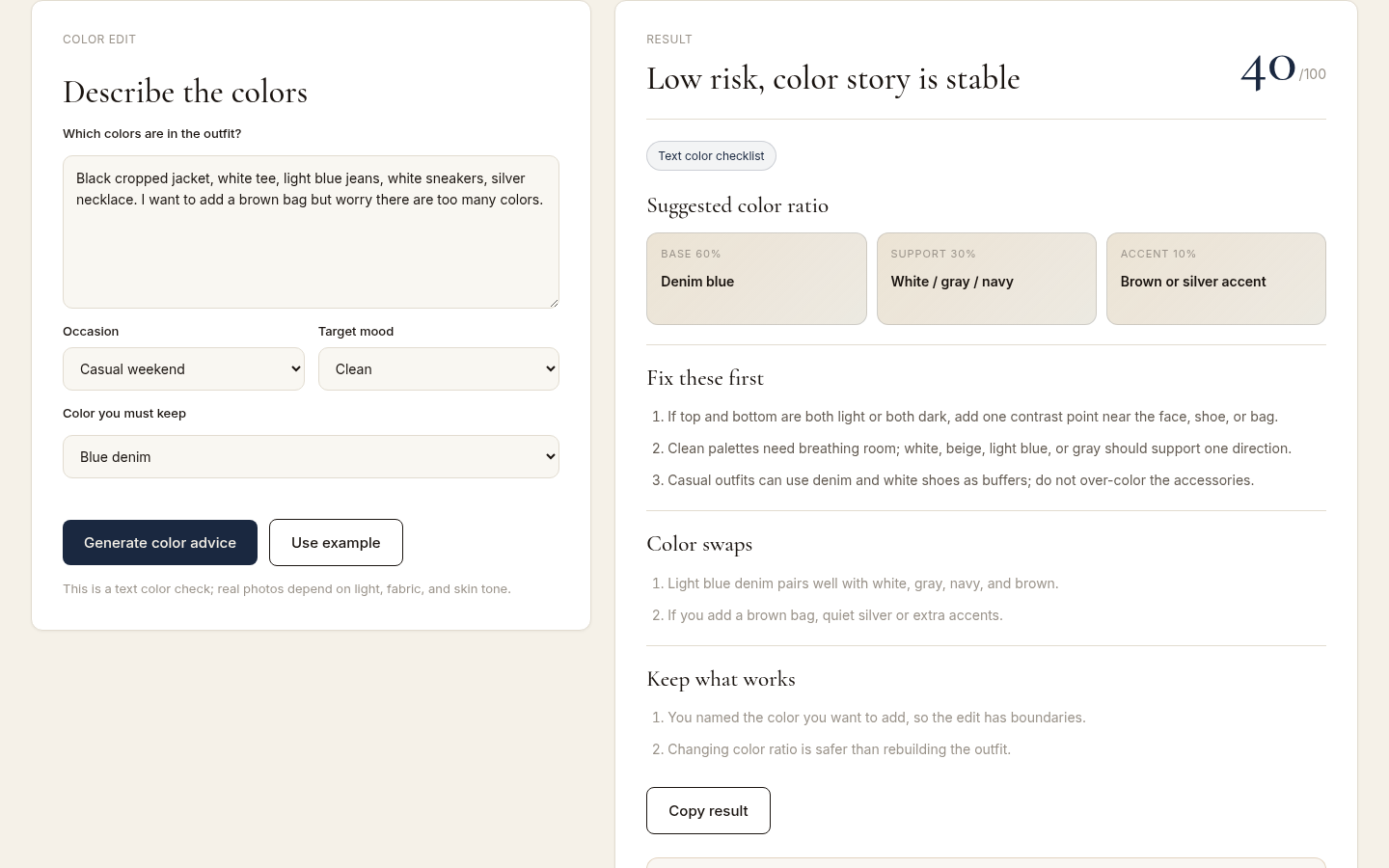
After submitting example outfit colors. Shows 'Low risk, color story is stable', 40/100 score, Suggested color ratio with Base 60% / Support 30% / Accent 10% breakdown. en-US.
Whichever route you take, use the result as one input, not a verdict: the check is there to catch a conflict before an interviewer does.
Interview color FAQ
What color should I wear to an interview? Navy or charcoal with a white or light-blue shirt is the safest combination across industries. Add one small accent if you want to show some personality.
What colors should I avoid for an interview? Avoid large areas of bright red, orange, neon yellow, and busy multi-color prints. Keep strong colors to a tie, scarf, pocket square, or small accessory.
Can I wear black to an interview? Yes, especially for formal, senior, creative, or evening-adjacent roles. In a casual workplace, black can look severe, so soften it with a lighter shirt or a textured layer.
What should I wear to a fast-food or retail interview? A plain, clean shirt in white, light blue, gray, or navy, dark trousers, and closed shoes. Skip the suit and the loud logos.
Does outfit color actually matter to interviewers? Less than your preparation and fit, and more than most candidates assume. Color is part of the first impression, so keep it conventional unless you have a reason not to.
How do I tell whether two colors clash? Put them side by side in daylight. If one turns muddy or the pair seems to vibrate, reduce one of them to a small accent or replace it with a neutral.
I am color-blind. How do I check my outfit? Work with contrast instead of color: choose pieces whose lightness clearly differs, ask someone one specific question such as whether this tie looks muddy against the shirt, or use a photo checker that returns a risk read rather than a color name.